Wednesday, June 30, 2010


Tuesday, June 29, 2010
Meet Nvar

This is Nvar (pronounced Nivar). She's 9 years old and has Tetralogy of Fallot. That means there are four different things wrong with her heart. She is one of the children who I get to accompany to surgery in Istanbul this July. Her family has been able to contribute to a good portion of her surgery creating the kind of partnership we love at PLC. This surgery will not be a handout that the Americans swooped in a provided for Nvar but a surgery that Nvar's father worked hard for at his job as a typist in a government office.

If you want to also contribute towards her surgery, if definitely wouldn't hurt...just sayin'...
Sunday, June 27, 2010
Build a ship vs. Yearn for the sea

“If you want to build a ship, don’t drum up the men to gather wood, divide the work and give orders. Instead, teach them to yearn for the vast and endless sea.”
– Antoine de Saint-Exupery
Here at PLC our sea is Iraq and it's children. We need to tell stories in a way that creates a yearning for more information concerning this country and the people live here. Sounds lovely, but is much easier said than done.
Saturday, June 26, 2010
Postcards from Hell
Postcards from Hell is a photo essay with images of the world's most failed states. "For the last half-decade, the Fund for Peace, working with Foreign Policy, has been putting together the Failed States Index, using a battery of indicators to determine how stable -- or unstable -- a country is. But as the photos here demonstrate, sometimes the best test is the simplest one: You'll only know a failed state when you see it." It's really worth checking out the rest of Postcards from Hell and taking a look at the Failed States Index.

3. Sudan - "In this scene, children crowd around a U.N. helicopter in the South Sudanese town of Akobo."

4. Zimbabwe - "The bad news is that Mugabe has kept up his dictatorial rule as if nothing had changed; for example, he celebrated his 30th anniversary in office to the spectacular fanfare seen here, where children display militant loyalty to the ruling party."

7. Iraq - Iraq rocketed to the top of the Failed States Index after a 2003 U.S. military invasion ousted the dictator Saddam Hussein and set off a period of violent turmoil. Amid the explosion of sectarian killings and reprisals that followed, more than 2 million Iraqis fled the country, and many have yet to return. Although Iraq has calmed dramatically since the violence peaked in 2007, the country remains deeply polarized along ethnic and religious lines. Recent parliamentary elections were among the freest in the Arab world, but were marred by suicide attacks and allegations of fraud, and a new government has yet to be named. Any number of factors could prove destabilizing going forward: tension over oil rights, latent Sunni-Shiite hostility, the pullout of U.S. combat troops by Sept. 1. An April 23 attack in Baghdad is pictured here, on a day when 58 died in similar assaults throughout the country.

16. Burma - "Most recently, a cease-fire between the minority Kokang and the Burmese military broke down, sending refugees pouring over the border with China. Here, a girl carries a basket through a market in the northern part of the country."

21. Uganda - "In office since 1986, the country's president, Yoweri Museveni, has come under increasing criticism in recent years for his kleptocratic rule and reluctance to give up power. Here, men rallying against Museveni burn a bus in protest. "
Friday, June 25, 2010
Thursday, June 24, 2010
We are going toward light

One of the things I have most enjoyed and been surprised to find are all the positive messages around the city. Not that I expected to find anything negative but it's refreshing to see messages of hope plastered across a public space.

This is one of my favorites.

This shop is near the bus stop closest to our house. On our first day in Suly we were sent off to the bazaar. We wandered through shops and wove through crowds for 2 hours before attempting to catch a bus home. Instead we never found a bus and ended up walking a significantly longer distance than my feet were ready to handle. Only when I saw this sign did I really know its ok, I would make it home soon.

This is in a creepy tunnel that goes under one of the main streets in Suly. Amidst the political grafitti the walls are coated with different colored pieces of paper that directly translates to, "Is your life delicious?" in Kurdish. What it essentially means is are you satisfied with your life or is your life all that you want it to be?

This is across the street from Parki Azadi which is a gigantic park in the middle of the city. It used to be an army base and there used to be mass graves full of the Kurdish people that Saddam had killed. But now it has been reclaimed as Freedom Park.
Who knows what other gems are hidden within this city. I look forward to discovering them all.
Wednesday, June 23, 2010
Dr. Aso is the Boss-O

There isn't much privacy in Aso's office. The examination room and waiting room are kind of combined into one large space. Everyone gets looked at with an audience and gets their diagnosis with an audience. (A woman in my ESL class described to me a gynecological visit that was the same set up. Can you imagine getting that kind of check up with a room full of people!?) Our photographers were able to come in and take all the pictures they wanted without really asking the parents (who's children are getting looked at for life threatening diseases!) or other staff. Granted they get what they needed and leave as soon as they could it still showed how little privacy was given in the situation.
Dr. Aso is an incredibly gracious man. He was very warm and welcoming and his spirit exuded optimism. He has learned to make due with the resources he has. After attending medical school in Italy Aso returned home to Kurdistan to help his people. He is a paying member of a pediatric cardiology association in Europe but is unable to be granted a visa to attend seminars. According to him it is because he is an Iraqi but no matter the reason without further training he cannot learn the newest techniques and improve his knowledge of the type of medical care so desperately needed here. Even Aso's supervisor does not know many of the procedures required to fix the children that come in their office so how can Aso become better?
Still he is creative with what he has. A girl around 7 or 8 came in to have her heart checked. I could never imagine a heartbeat could be so irregular and a person still be alive. But here she was sitting by me with her huge brown eyes staring at me while I made really excited faces in an effort to make her feel like everything was ok. Aso wanted to hear what her heart rate was like after some exercise. Many doctors have a treadmill or something handy for these situations. Instead he dramatically waved his arms around and smiled wide as he told her to go run up and down the stairs three times. Once she returned, he checked her again and told us with medicine she would be completely fine.

The machine Dr. Aso uses to see into a child's chest was given to him by Italian partners. The part that is run over the heart (which looks similar to what is used for a sonogram) is normally used on 1,000 patients before being replaced. Aso has used his on over 4,000 patients. He said his western counterparts are always shocked when they hear that. Apparently the picture on the echo machine (which is the TV-like screen that shows the heart function) is getting fuzzy. Dr. Aso said this offhand but I'm assuming American doctors would balk at that fact.
During the few hours we were there Dr. Aso was continuously explaining to us what was going on and answering any questions we had. On the one hand this was very helpful and nice of him to do. On the other hand I felt bad that we were getting critical information before the parents. Some of the parents seemed annoyed at our presence, some kind of excited and others ambivalent. One younger mother had brought her toddler in because at different appointment a doctor said her son had an enlarged heart. She looked so worried and constantly on the verge of tears as she tried to calm her squirmy son. While Dr. Aso was talking to us about what was going on I tried to keep smiling at her to some how lessen her stress. She waited so patiently to hear the diagnosis that could change her and her son's life forever. The diagnosis we were being told first. Luckily, the boy was completely fine. You could see every muscle in the young mother's body relax as she heard the good news. It was like she melted but in the best possible way.
The last amazing thing we experienced in that office was this...

Baby Abdul came into the office with his father. (Read this amazing PLC blog post written by Esther about Abdul and his father. Especially read the second to last paragraph.) We got to watch Aso diagnose him with a very serious heart condition (he's already had one surgery but it's benefits are only a temporary fix) and then recommend PLC to Abdul's father. When we returned to the office Lydia showed us the above picture and we learned that they came straight over to meet Jeremy and discuss their options. Now baby Abdul is going to be a part of the Remedy Mission!!!!
This is why Remedy is so important. With this one event, Dr. Aso will get training from highly educated doctors, 30 children like Abdul will be able to see their next birthday and 30 families will rejoice because their children are on their way to better health.
The day I went to the hospital for this visit had started out terribly but it ended up being good for my heart. And that's exactly what Dr. Aso is there for, to fix hearts.
Best meal ever.

I want to meet the man who cooks this food and shake his hand (except that's culturally inappropriate), I want to write a letter to the President of Iraq and tell him America thanks him for this chicken, and I want to evangelize on behalf of Sara. If you didn't have a reason to visit Sulaimania before, you obviously do now.
Sunday, June 20, 2010
Preemptive Flickr

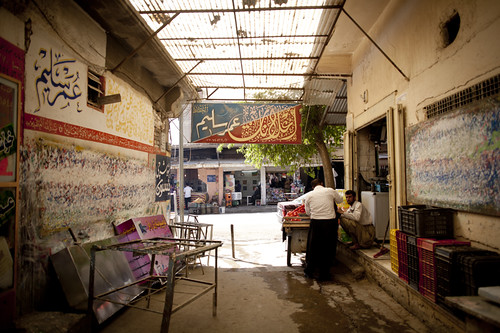

Aren't you really impressed by the high quality of these photos? I know, they're great! If you want to see more you can go to PLC's Flickr!!
Saturday, June 19, 2010
The Refugee Flow
"Some 43.3 million people were forcibly displaced worldwide at the end of 2009, the highest number of people uprooted by conflict and persecution since the mid-1990s, according to UNHCR's annual 2009 Global Trends report, released today. At the same time, the number of refugees voluntarily returning to their home countries has fallen to its lowest level in twenty years." Read the full article from The UN Refugee Agency.

"Simply put, as conflicts rumble on, those who fled the initial fighting cannot safely return until the gunfire falls silent.
The key drivers of these trends are continuing conflicts in countries such as Afghanistan, Somalia and the Congo, Democratic Republic of and as-yet-unresolved situations in places such as Iraq and Sudan. Colombia's 3.3 million internally-displaced persons is the highest in the world, with African nations accounting for 40% of the world's internally-displaced population.
Most interesting, perhaps, is the rubbishing of so-called conventional wisdom with regards to refugee relocation. Forget our over-burdened immigration system; four out of every five refugees are housed in the developing world, with Europe only accounting for the resettlement of 16% of the global population.
So who takes the most refugees? Pakistan leads the way, with 1.7 million, and Iran and Syria, at just over 1 million each, make up the podium. The US and the UK? They barely make the Top 10."
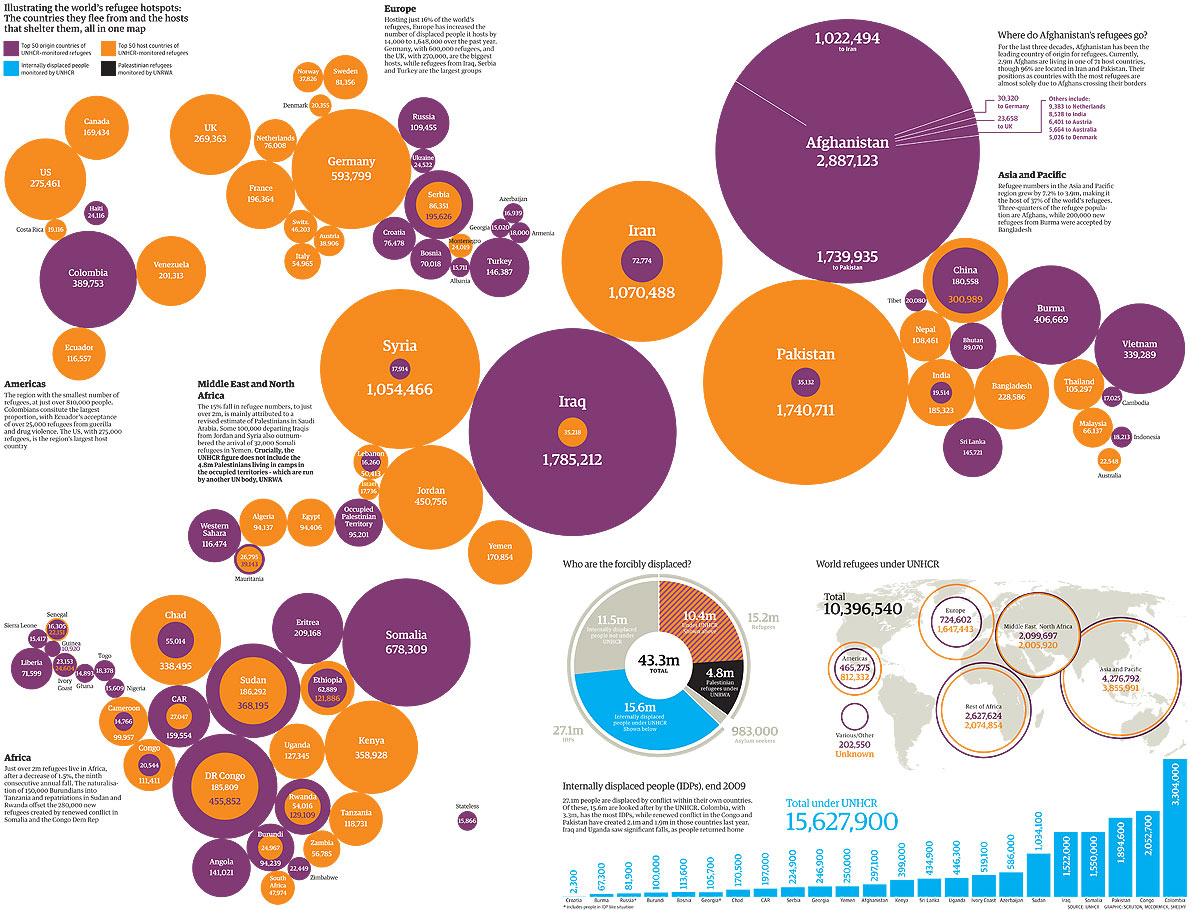
View a larger version of the infographic here!
The key drivers of these trends are continuing conflicts in countries such as Afghanistan, Somalia and the Congo, Democratic Republic of and as-yet-unresolved situations in places such as Iraq and Sudan. Colombia's 3.3 million internally-displaced persons is the highest in the world, with African nations accounting for 40% of the world's internally-displaced population.
Most interesting, perhaps, is the rubbishing of so-called conventional wisdom with regards to refugee relocation. Forget our over-burdened immigration system; four out of every five refugees are housed in the developing world, with Europe only accounting for the resettlement of 16% of the global population.
So who takes the most refugees? Pakistan leads the way, with 1.7 million, and Iran and Syria, at just over 1 million each, make up the podium. The US and the UK? They barely make the Top 10."
Subscribe to:
Posts (Atom)


